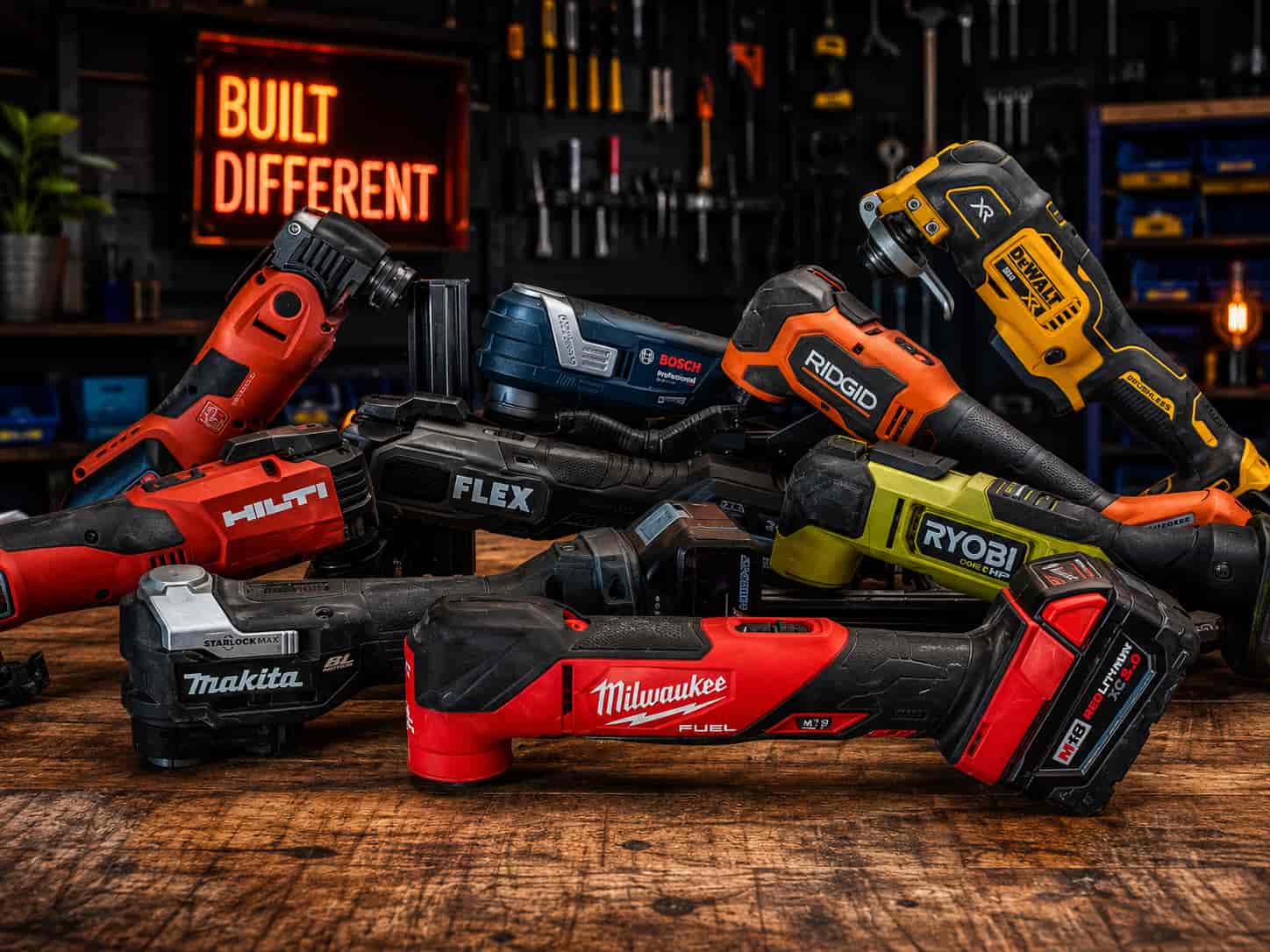

🔧 Best Oscillating Tools: The Complete Power-Tool Guide for Cutting, Sanding & Grout Removal
Oscillating multi-tools are the Swiss Army knives of the workshop — but choosing the right tool, blade, and attachment combo makes the difference between a clean cut and a chewed-up mess. Here’s everything you need to know, from blade metallurgy to grout-removal technique.
🛠️ What Is an Oscillating Tool, and Why Does It Matter?
An oscillating tool drives its attachment back and forth in a tight arc — typically between 1.5° and 4° — at speeds ranging from roughly 10,000 to 21,000 oscillations per minute (OPM). That rapid, short-throw motion is what makes the tool so versatile: the same body can cut wood, slice through nails embedded in framing, scrape adhesive, sand tight corners, and grind out grout, simply by swapping the attachment.
The category traces back to the dental and surgical world, where oscillating saws were developed to cut casts without injuring skin underneath — the oscillation prevents the blade from “grabbing” soft material. Fein adapted this technology for woodworking and renovation in the 1960s, and the modern oscillating multi-tool format (often still called by the genericized term “Multimaster,” a Fein trademark) has since become a staple in every contractor’s bag.
For a deeper technical breakdown of oscillation mechanics and tool history, Fein’s own engineering documentation remains one of the most authoritative sources: Fein Official Site.
⚙️ Core Spec Categories to Compare Before You Buy
Power Source
Corded models deliver consistent 2.5–3.5 amp draw for long sessions; cordless 18V/20V units offer freedom but rely on battery capacity (4.0Ah+ recommended for demolition work).
Oscillation Angle
A wider arc (3.0°–3.4°) removes material faster but produces more vibration. Narrower arcs (1.4°–2.0°) favor precision detail sanding and flush-cutting.
Tool-Free Blade Change
Quick-release systems (lever or twist-lock) cut blade-swap time to under 5 seconds — essential when alternating between wood, metal, and grout attachments mid-job.
Variable Speed Dial
A 6-position dial (commonly 8,000–20,000 OPM) lets you drop speed for delicate veneers or ramp up for hardwood and metal cutting.
Dust Management
Integrated dust ports or shroud attachments matter most for grout removal and drywall sanding — without one, expect a visible cloud within seconds.
Vibration Control
Counterbalance mechanisms inside premium housings reduce hand fatigue significantly during extended cutting sessions — a key differentiator in pro-grade models.
🔪 Best Oscillating Tool Blades: Matching Material to Metallurgy
Blade selection is arguably more important than the tool body itself. The three dominant blade materials are High Carbon Steel (HCS), Bi-Metal (BIM), and Carbide/Titanium-coated. Each is engineered for a specific material hardness range, and using the wrong one is the single most common cause of premature blade failure.
🌲 Best Blades for Wood
High Carbon Steel (HCS) blades are the standard choice for clean wood, drywall, and plastics. Their teeth are ground at an aggressive rake angle for fast material removal. For flush-cutting around door jambs or trim, a narrow-profile HCS blade with a curved tip prevents gouging adjacent surfaces. Tooth pitch matters here too — coarser pitch (around 6–8 TPI) clears softwood chips quickly, while finer pitch (10–14 TPI) leaves a smoother edge on hardwoods and plywood veneers.
🔩 Best Blades for Metal
Bi-Metal (BIM) blades combine a flexible spring-steel body with welded high-speed-steel (HSS) teeth, giving them the toughness to survive nail-embedded wood and the hardness to bite into mild steel, copper pipe, and aluminum flashing. For stainless steel or hardened fasteners, step up to a Titanium-Nitride (TiN) coated bi-metal blade — the coating reduces friction heat, which is the primary cause of premature tooth-set wear when cutting metal. Carbide-tipped blades are reserved for the toughest jobs: cast iron, fiberglass, and abrasive composite materials where standard bi-metal teeth would dull within minutes.
🧱 Best Oscillating Tool for Grout Removal: Technique and Attachment Choice
Grout removal is one of the toughest jobs an oscillating tool can take on, because grout is abrasive, brittle, and dust-heavy. A dedicated carbide grout removal blade — typically a thin, rigid blade coated in carbide grit along the cutting edge — is essential. Standard wood or metal blades will dull almost instantly against cured cement-based grout.
For best results, run the tool at a moderate-to-high OPM (around 15,000–18,000), keep the blade flat against the grout line, and make multiple shallow passes rather than trying to remove the full depth in one go. Pressing too hard risks chipping the surrounding tile edges — a mistake that’s far more costly to fix than the grout itself.
Many premium kits include a dedicated dust shroud attachment specifically for grout work. If yours doesn’t, a shop vacuum with a narrow crevice nozzle held near the cutting point dramatically improves visibility and air quality, especially when working with older grout that may contain silica dust.
🧰 Best Oscillating Tool Attachments & Accessories
The real value of an oscillating tool system lies in its accessory ecosystem. Beyond saw blades, here are the attachments that consistently deliver the most utility per dollar:
Sanding Pads & Sheets
Delta-shaped (triangular) sanding pads with hook-and-loop attachment reach into corners standard orbital sanders can’t touch — ideal for stair stringers and window frames.
Scraper Blades
Rigid flat scrapers remove caulk, vinyl flooring adhesive, and old paint without gouging the substrate beneath, thanks to the controlled oscillating action.
Universal Adapters
Universal “StarLock” or OIS-style adapters let you mix blades across brands — a major upgrade if you’ve accumulated tools from multiple manufacturers over the years.
Plunge-Cut Blades
Wide, rounded-tip blades designed specifically for plunge cuts into drywall — useful for cutting outlet boxes or HVAC vent openings cleanly.
Polishing & Buffing Pads
Foam-backed pads with felt or microfiber covers work well for spot-polishing metal trim and removing oxidation from small surfaces.
Carrying Case & Organizer
A molded case with individual blade slots prevents the single most common accessory failure: chipped carbide teeth from blades rattling loose in a tool bag.
📋 Maintenance Schedule & Common Failure Points
| Component | Common Failure | Recommended Action | Interval |
|---|---|---|---|
| Tool-free clamp mechanism | Loosens, causing blade wobble | Re-tighten clamp lever; inspect spring tension | Every 10–15 hours of use |
| Carbon brushes (corded models) | Reduced power, intermittent operation | Inspect and replace when worn below 6mm | Every 100–150 hours |
| Gearbox / oscillating mechanism | Increased noise, grinding feel | Re-grease internal gears with manufacturer-spec lithium grease | Annually or every 200 hours |
| Battery contacts (cordless) | Intermittent power loss | Clean contacts with isopropyl alcohol and a dry brush | Every 3 months |
| Air vents / motor housing | Overheating, thermal shutoff | Blow out dust with compressed air | Every 5–10 hours in dusty environments |
| Blade teeth (general) | Dulling, chipped carbide tips | Rotate blade stock; replace once cut speed drops noticeably | Per job / as needed |
🔩 Commonly Replaced Parts (Reference Chips)
Tool-free blade clamp assembly — replaces worn lever-release clamps on most 1.4°–3.0° oscillation models.
Carbon brush set (pair) — standard fit for corded motors in the 2.5–3.0 amp range.
Dust extraction shroud — attaches to the nose of the tool for grout and drywall sanding applications.
Universal blade adapter — converts proprietary blade shanks to universal StarLock-style fitment.
Internal gearbox grease pack (synthetic lithium) — sized for a single full re-pack of the oscillation mechanism.
Replacement clamp spring — restores correct clamping tension when blades begin to slip mid-cut.
⚖️ Oscillating Tools: Pros & Cons
✅ Pros
- Extremely versatile across cutting, sanding, scraping, and grinding tasks
- Compact size reaches tight corners other power tools can’t
- Tool-free blade changes save significant time on multi-task jobs
- Lower kickback risk compared to circular saws or angle grinders
- Wide accessory ecosystem extends the tool’s lifespan and utility
❌ Cons
- Cutting speed is slower than dedicated saws for long, straight cuts
- Blade costs add up quickly if multiple materials are cut regularly
- Vibration can cause hand fatigue during extended sessions
- Cross-brand blade compatibility can be limited without adapters
- Dust control requires additional attachments on base models
🛒 Where to Compare Models & Pricing
📜 A Brief History of the Oscillating Tool
The oscillating tool’s lineage runs through medical equipment manufacturing. The core principle — converting rotary motor motion into a small back-and-forth oscillation via an eccentric cam and counterweight — was originally refined for surgical cast saws, where the goal was a blade that could cut rigid plaster but stop short of cutting soft tissue underneath due to the limited stroke length.
Fein engineers recognized that the same mechanical principle solved a long-standing renovation problem: how to make precise plunge cuts into walls, floors, and trim without the runaway risk of a spinning blade. The company’s early “Multimaster” line in the latter half of the 20th century established the proprietary star-shaped blade mount that became an industry reference point — eventually standardized more broadly as the “StarLock” interface to improve cross-brand compatibility.
Since then, the category has expanded dramatically in both directions: compact cordless models aimed at DIY users, and heavy-duty corded units built for daily jobsite abuse. The underlying oscillation mechanism, however, has remained remarkably consistent — a testament to how well the original cam-and-counterweight design solved the problem. For a general overview of oscillating mechanism engineering principles, the Wikipedia entry on power multi-tools offers a useful starting reference.
🎯 Tuning Tips for Better Performance
Match Speed to Material Density
Running every material at maximum OPM is the most common beginner mistake. Hardwoods and metals benefit from mid-range speeds (10,000–14,000 OPM) paired with steady pressure, while soft materials like drywall and foam insulation cut cleanly even at low speeds (8,000–10,000 OPM) — reducing both blade wear and dust spread.
Let the Blade Do the Work
Oscillating blades cut through the rapid arc motion, not through downward force. Excessive pressure doesn’t speed up the cut — it increases friction heat, which is the leading cause of premature blade dulling, especially on bi-metal and carbide blades used for metal and grout work.
Keep a Multi-Material Blade Kit On Hand
Because blade swaps take seconds on tool-free systems, keeping a small kit with one HCS wood blade, one bi-metal metal blade, one carbide grout blade, and one sanding pad covers roughly 90% of common renovation tasks without a second trip to the truck.
❓ Frequently Asked Questions
🔹 What’s the difference between an oscillating tool and a rotary tool?
An oscillating tool moves its attachment back and forth in a narrow arc (typically 1.5°–4°), making it ideal for plunge cuts and flush trimming with minimal kickback. A rotary tool spins continuously at high RPM, better suited for grinding, engraving, and continuous cutting where a full rotation is needed.
🔹 Can I use the same blade for both wood and metal?
Bi-metal blades can technically cut both, but for best results and longest blade life, use a high-carbon-steel blade for clean wood and switch to a dedicated bi-metal or titanium-coated blade when metal — especially nails or fasteners — is involved.
🔹 Why does my oscillating tool struggle with grout?
Standard wood or metal blades dull almost instantly on cured grout because grout is highly abrasive. A carbide-grit grout removal blade is required, and scoring the grout surface first with a utility knife significantly improves cutting speed and blade longevity.
🔹 How often should I replace the carbon brushes on a corded model?
Most corded oscillating tools need brush inspection roughly every 100–150 hours of use. Replace the brushes once they wear below approximately 6mm, as continuing to run worn brushes can damage the motor’s commutator.
🔹 Are universal blade adapters worth buying?
If you own tools from multiple brands or have accumulated blades with different shank designs over time, a universal adapter is a worthwhile small investment — it lets you use your existing blade collection across any tool with a compatible mount.
🔹 What oscillation angle is best for general use?
A mid-range oscillation angle of around 2.8°–3.0° offers the best balance for general-purpose work, combining reasonably fast material removal with manageable vibration levels for most cutting, sanding, and scraping tasks.