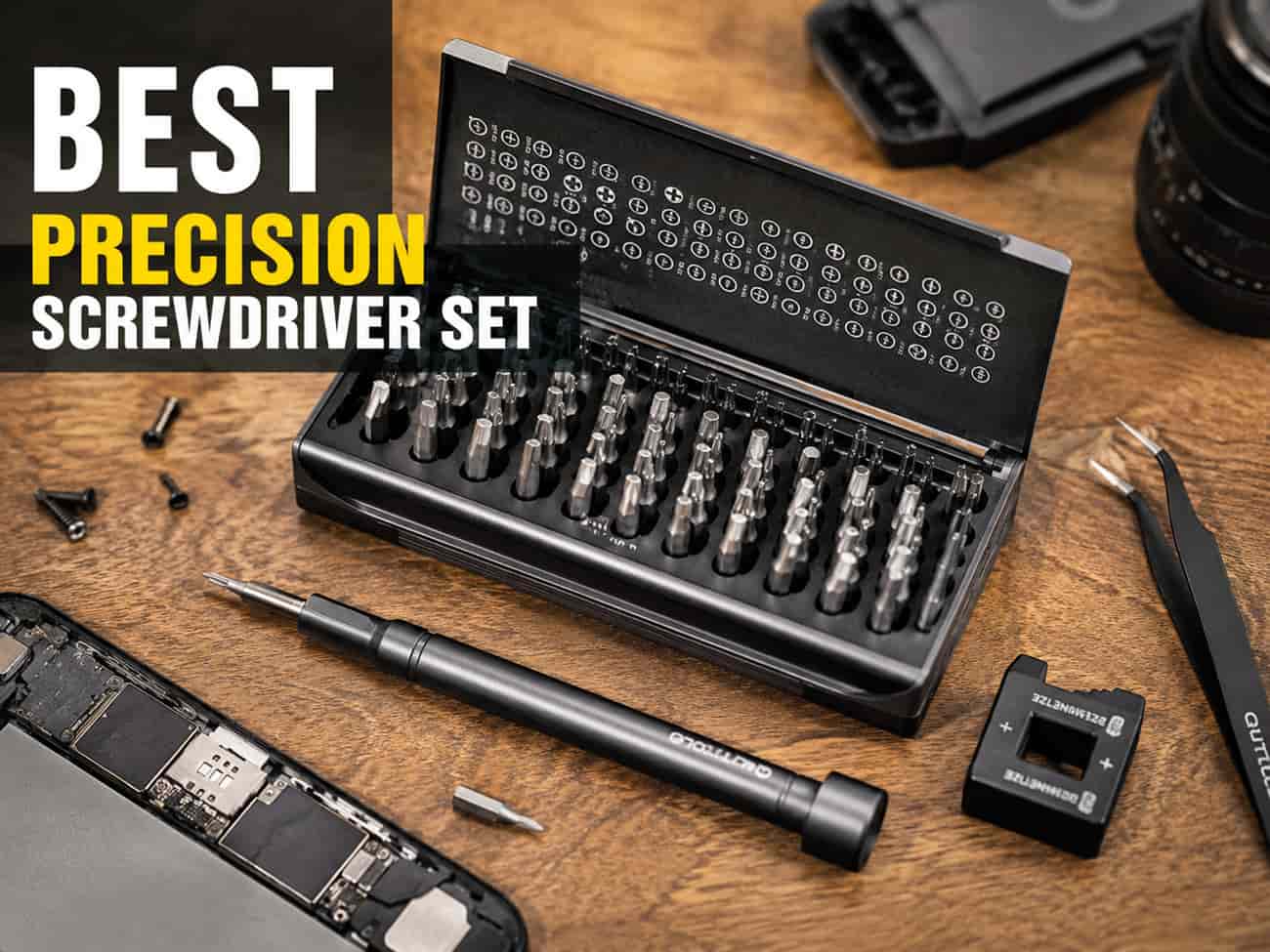
Expertly Tested & Verified Guide
🔩 Best Precision Screwdriver Sets for Electronics — The Definitive Technical Guide
Master-level insights into bit metallurgy, drive standards, ESD safety, torque mechanics, and hands-on repair scenarios — everything you need to choose, use, and maintain the ultimate precision screwdriver set for electronics work.
🔬 Electronics Repair
⚡ ESD-Safe Picks
🔋 Electric Sets
🏆 Pro-Grade Tools
🧲 Magnetic Tips
🛠️ Multi-Bit Kits
🔩 Bit Steel: S2 / CR-V / Moly
📐 Tip Range: PH000 → T40 Torx & Beyond
💪 Torque: 0.02 – 5 N·m
🛡️ ESD Rating: ≤1 kΩ Surface Resistance
🔋 Electric RPM: 150 – 300 RPM
🔍 Why does a budget precision screwdriver set fail where a professional one thrives? The answer lies deep in the metallurgical composition of the bit, the geometry of the drive profile, the anti-roll design of the handle, and — for modern electric sets — the sophistication of the torque-limiting clutch. Whether you’re disassembling a flagship smartphone, servicing a drone’s flight controller, repairing a game console’s motherboard, or restoring a vintage synthesizer, the wrong precision screwdriver can strip a pentalobe P2 fastener irreversibly and transform a 20-minute fix into a catastrophic parts search. This comprehensive guide delivers the engineering truth behind precision screwdriver sets — and tells you exactly which kits belong on your workbench.
📜 From Slotted to Pentalobe: A History of Precision Drive Standards
The story of precision screwdrivers is inseparable from the miniaturization of consumer electronics. For most of the 20th century, slotted (flathead) and Phillips drives dominated assembly lines. The Phillips design was engineered to “cam out” under high torque — a clever feature for automated assembly robots but a frustrating liability for hand-repair technicians working on delicate printed circuit boards.
The shift toward consumer electronics miniaturization — from desktop PCs to portable music players and then to mobile phones — created engineering pressure for smaller, more reliable fastener systems. The JIS (Japanese Industrial Standard) cross-head screw, visually similar to Phillips but with a shallower cam angle (15° vs. Phillips’ 27°), became the standard in Japanese consumer electronics. A JIS screwdriver on a JIS screw prevents the destructive cam-out that ruins so many circuit board housings when the wrong tool is used.
A pivotal moment came when Apple introduced a five-lobed pentalobe fastener — first appearing in early MacBook Pro ultrabooks and subsequently in every iPhone as the P2 external case screw. The pentalobe was specifically engineered to resist third-party servicing, forcing the repair community to develop matched precision tooling and sparking the modern precision screwdriver industry’s next leap forward.
Today’s premium kits address over 50 distinct drive standards, from Torx T1–T10 (used in hard drives, game controllers, and automotive ECUs), to Tri-wing Y0 (Nintendo handhelds), JIS #000 (Japanese vintage PCBs), and TS9 Torx Security (Xbox gamepads). The precision tool has not just caught up with the fastener — it has surpassed it.
⚙️ Bit Metallurgy: Why S2 Steel Changes Everything
🔬
S2 Modified Tool Steel — Heat-treated to 60–62 HRC hardness, S2 combines high tensile strength with exceptional torsional resistance. Used in Wiha, Wera, and iFixit’s professional lines, it resists tip deformation on stubborn fasteners where softer alloys mushroom and slip. The industry benchmark for electronics repair bits.
🏗️
Chrome Vanadium (CR-V) — The industry-standard alloy for mid-range precision sets. Good hardness (55–58 HRC) at competitive cost. Common in ORIA, Jakemy, and similar brands. Perfectly adequate for occasional light repairs but shows measurable wear under heavy daily professional use.
✨
Tungsten Carbide Coating — Applied to the tip surface for enhanced wear resistance, a coating found on select Wera Kraftform Micro bits. This surface treatment extends tip life by a factor of 2–3× compared to bare steel — critical when working with hardened stainless fasteners in MacBooks and enterprise laptops.
🧲
Precision Magnetic Tip Treatment — Controlled magnetization (typically 50–150 mGauss at the tip) allows bits to hold miniature M1.2–M2.0 screws without dropping them into PCB traces. Professional kits include both a magnetizer and a demagnetizer for sensitive sensor work on compass ICs and magnetometers.
⚡
ESD-Safe Composite Handles — For PCB work and sensitive component handling, ESD-compliant handles dissipate static at ≤1kΩ, preventing damage to MOSFET gates, NAND flash controllers, and other static-sensitive components. Rated to the ANSI/ESD S20.20 and IEC 61340-5-1 standards.
📏
Tip Geometry Tolerance — German-engineered tips (Wiha, Wera) maintain ±0.01mm dimensional tolerance, ensuring the bit fills the fastener recess completely. This “form-fit” contact maximizes torque transfer at the drive interface while minimizing the risk of recess wall deformation on hardened stainless screws.
💡
🔩 Pro Tip: The 70 / 30 Pressure Rule
Before rotating any precision screwdriver, apply 70% downward axial pressure and only 30% rotational force. This technique prevents cam-out — the single most common cause of stripped fasteners in phone and laptop repair. Precision bits function correctly only when they are fully seated in the drive recess with proper engagement across all contact surfaces. A stripped iPhone pentalobe screw can sometimes be rescued using a dedicated screw extractor bit, but prevention is always faster and cheaper than recovery.
🏆 Top Precision Screwdriver Sets: Expert Spec Breakdown
After rigorous hands-on evaluation across real electronics repair scenarios — smartphone battery replacement, laptop SSD swaps, drone motor servicing, game controller refurbishment, and vintage audio restoration — these are the precision screwdriver sets that earned their place on a serious workbench.
🥇
Best Overall Kit
iFixit Manta Driver Kit (112-Bit)
The gold standard for electronics repair. Features S2 steel bits precision-machined to ±0.05mm, a swivel-top handle, and a 64-position ratcheting driver. The 112-bit count covers virtually every consumer electronics drive standard — iPhone P2 pentalobe, MacBook T5 Torx, Xbox T8 Torx Security, Nintendo Y00 Tri-wing, and dozens more — all in an organized magnetic roll case. Backed by
iFixit’s comprehensive repair database.
⚡
Best ESD-Safe Set
Wera Kraftform Micro ESD (9-Piece)
Wera’s celebrated Kraftform ergonomic handle meets ESD-compliant materials rated ≤1kΩ surface resistance. The Lasertip surface micro-etching on Phillips and Pozidrive profiles grips fastener recesses at the microscopic level — a genuine engineering innovation that measurably reduces cam-out probability. Manufactured in Germany to
DIN ISO 8764 standards and compliant with IEC 60900.
🏗️
Best German Engineering
Wiha 26190 Slotted & Phillips Set
Manufactured in Germany under ISO 9001 quality management, the Wiha 26190 series features precision-ground S2 Molybdenum steel tips and their tri-component ergonomic handles. Color-coded by drive type and size, this system eliminates fumbling during time-critical repairs. A reference-standard kit trusted by
Wiha-certified service centers in industrial and telecom applications worldwide.
💰
Best Value for DIY
ORIA Precision Screwdriver Set (60-Bit)
Exceptional value — CR-V steel bits covering 60 drive standards, housed in a magnetic driver with a rotating cap and a molded hard-case organizer. While not at Wera’s hardness levels, the dimensional accuracy is competitive in this price class. Includes a flexible shaft extension and a 300mm extension bar for deep-cavity access in desktop towers and rack-mount equipment.
🎯 Home Repair & DIY
🔋
Best Electric Precision Set
Wowstick 1F+ Electric Precision Driver
The leading electric precision screwdriver for electronics technicians. A Li-Ion cell delivers 200RPM with a torque ceiling of 3 N·m — sufficient for M2 and M2.5 laptop fasteners, yet gentle enough for M1.2 smartphone screws in its lowest power mode. Ships with 56 bits, an integrated LED work light, and USB-C charging. Bidirectional with a precision manual-mode fallback mechanism for delicate final-seating work.
⚡ High-Volume Repairs
🎮
Best for Gaming & Consoles
Jakemy JM-8150 (53-Bit Mega Kit)
Tailored for gaming console repair, this kit’s standout feature is comprehensive Tri-Wing Y0/Y00 coverage for Nintendo Switch, Joy-Con internals, and the DS handheld series. Solid CR-V bits with adequate hardness for console-grade alloy fasteners. The slide-out bit organizer is best-in-class at this price point — tactile slot friction keeps bits secure during benchtop work and transport alike.
🕹️ Console & Peripheral Repair
🔋 Electric Precision Screwdriver Sets: Complete Technical Picture
⚡ Should you go electric? Electric precision screwdrivers dramatically accelerate high-volume repetitive disassembly — think production-level phone screen replacement — while introducing risks that manual work avoids: over-torquing delicate fasteners, gyroscopic forces on small PCBs, and potential EMI interference near sensitive magnetometer ICs. The key differentiator in any quality electric precision set is configurable torque limiting, delivered either as a mechanical clutch or a software-controlled motor stall threshold.
The core mechanics of an electric precision screwdriver center on a brushless DC micro-motor (BLDC) with planetary gear reduction. The gear ratio determines output RPM and torque multiplication. High-end electric sets use a harmonic drive (strain wave gear) for zero backlash and exceptional positional repeatability — the same principle found in industrial robot joints and precision satellite antenna actuators.
Critical specifications when evaluating any electric precision screwdriver set for electronics work:
🔄
No-Load RPM: Target 150–250 RPM for electronics applications. Speeds above 400 RPM risk thread-stripping plastic bosses and M1.4 fasteners in smartphone chassis.
💪
Torque Ceiling: The precision electronics sweet spot is 0.5 – 3 N·m. Note that manufacturer-rated torque is typically measured at stall; operational torque at running speed is usually 60–70% of the stated value.
🔋
Battery Specification: Li-Ion ≥ 500mAh for meaningful run-time. USB-C charging is non-negotiable — micro-USB ports represent a red flag for longevity and forward compatibility in any modern kit.
🎯
Torque Clutch Mechanism: A mechanical or electronic clutch that disengages at a preset threshold is non-negotiable for M1.6 and smaller fasteners, where tactile feel-based control alone is insufficient to prevent over-torquing.
💡
Integrated LED Work Light: Illumination at the bit tip is a genuine productivity multiplier during chassis work — not a marketing gimmick. An interior phone chassis under a light source rarely receives adequate direct illumination without it.
🔩
Bit Interface Standard: The best electric sets accept standard 4mm hex shanks, making them fully compatible with Wera, Wiha, iFixit, and PB Swiss precision bit ecosystems — dramatically expanding your available drive coverage.
🥊 Electric vs. Manual: The Honest Comparison
⚡ Electric Set Strengths
- Dramatically faster on high-count disassembly (10–15 screws per device)
- Eliminates hand fatigue in production-volume repair environments
- Consistent torque delivery removes human variability from the process
- Forward/reverse switching reduces repetitive wrist strain injury risk
- Integrated LED dramatically improves visibility inside chassis
- Compact in-handle bit storage keeps workspace organized
⚠️ Electric Set Limitations
- Higher initial cost than comparable-quality manual kit
- Over-torque risk on M1.2 fasteners and plastic-boss assemblies
- Minor measurable EMI output near magnetometer sensor ICs
- Battery dependency — zero utility when depleted mid-repair
- Reduced tactile feedback versus a quality manual ratchet set
- Heavier and less maneuverable in extremely confined recesses
📊 Precision Screwdriver Set Comparison Table
| 🔩 Set / Model |
📦 Bit Count |
⚙️ Bit Steel |
🛡️ ESD |
🔄 Ratchet |
⚡ Electric |
🎯 Primary Use |
💰 Tier |
| iFixit Manta 112-Bit |
112 bits + 2 handles |
S2 Tool Steel |
❌ |
✅ 64-pos |
❌ |
General electronics repair |
Professional |
| Wera Kraftform Micro ESD 9pc |
9 screwdrivers (fixed) |
S2 + Lasertip |
✅ ≤1kΩ |
❌ |
❌ |
PCB & live circuit work |
Professional |
| Wiha 26190 (Germany) |
6 screwdrivers (fixed) |
S2 Moly Steel |
✅ ESD grips |
❌ |
❌ |
Industrial & service centers |
Professional |
| MOODY TOOLS 58-0358 |
6 screwdrivers (fixed) |
High-Carbon Steel |
✅ VDE-rated |
❌ |
❌ |
Industrial / Mil-Spec precision |
Professional |
| Wowstick 1F+ Electric |
56 bits |
CR-V (included) |
Partial |
N/A |
✅ 200 RPM |
High-volume phone repair |
Mid-Range |
| Xiaomi Wowstick 1P Pro |
25 bits |
S2 (claimed) |
❌ |
N/A |
✅ 300 RPM |
Minimalist carry kit |
Mid-Range |
| ORIA Precision 60-Bit |
60 bits + driver |
CR-V Steel |
❌ |
❌ |
❌ |
DIY & home repair |
Budget-Pro |
| Jakemy JM-8150 |
53 bits |
CR-V Steel |
❌ |
❌ |
❌ |
Gaming consoles & peripherals |
Mid-Range |
💀 Common Failure Modes & How the Right Set Prevents Them
Understanding failure modes is as important as selecting the right screwdriver set. The following are the most frequently encountered — and most preventable — precision fastener failures in electronics repair, along with specific part numbers and engineering solutions where applicable.
😱
Most Common Failure
Stripped Phillips #000 (Logic Board Shields)
Caused by using a worn PH0 bit on a JIS #000 screw — a common mistake on iPhone and Android logic board shield plates. JIS cross-recesses have a shallower cam angle and differ from Phillips at the tip geometry level. Use JIS-specific bits (Vessel 930 PLUS series, PB Swiss 8192 Z) and apply the 70/30 pressure rule. Recovery requires an adhesive method (rubber on the recess) or a dedicated micro screw extractor.
📱 Smartphone Logic Boards
⭐
Specialty Drive Damage
Pentalobe P2 External Cam Failure
iPhone bottom screws (P2 pentalobe, 3.6mm head diameter) are frequently damaged by off-axis bit insertion. The P2’s five-lobe geometry requires near-perfect axial alignment — even 3° off-axis contact progressively deforms the lobes. Always use a swivel-top handle that maintains bit perpendicularity. When reassembling, many technicians replace P2 screws with standard Phillips M1.2 fasteners for future access ease.
🔺 iPhone External Case
🎮
Gaming Hardware
Tri-Wing Y0 Rounding (Nintendo)
Nintendo’s Tri-Wing Y0 (1.5mm head) — used in Game Boy Color shells, DS handheld cases, Wii remote battery covers, and Joy-Con rail fasteners — rounds immediately when an off-brand bit engages. Precision Y0 bits (PB Swiss #PB 1205, iFixit #IF145-365-1) maintain a 0.01mm tighter fit than generic alternatives. That tolerance is the entire difference between a clean extraction and permanent damage to an irreplaceable screw head.
🕹️ Nintendo Hardware
💻
Laptop Repair
T5 Torx Cam-Out (MacBook Logic Board)
MacBook Pro logic board and battery connector bracket screws use T5 Torx (2.5mm inscribed circle diameter). Low-quality T5 bits — those not holding the full ±0.02mm star-engagement tolerance — cam out and deform the screw head under even light torque. Wera’s 867/1 Z T5 Torx bit (part: 05059489001) with its Compound Geometry 2 tip design is the field-proven solution for full six-lobe engagement with MacBook-grade stainless fasteners.
🍎 MacBook Pro / Air
🚁
Drone & RC Electronics
M2 Hex Galling in Carbon Fiber Drone Arms
Carbon fiber drone arms with M2 socket cap screws (2mm hex drive) suffer from galling — metallic adhesion between the bit and hardened steel inserts in the carbon laminate. Prevention: use a ball-end hex bit (15° off-axis approach) and apply one minimal drop of medium-strength threadlocker (Loctite 243) after verifying fit. Wiha 352 series ball-end hex screwdrivers are purpose-designed for exactly this scenario.
✈️ FPV & Racing Drone
🔊
Vintage Audio Restoration
JIS #1 Cross-Head on Vintage Amplifier PCBs
Japanese-manufactured amplifiers from Yamaha, Sansui, Pioneer, and Technics universally use JIS cross-point screws on their PCBs — NOT Phillips. A Phillips #1 bit will immediately strip a JIS #1 screw due to the 12° difference in cam angle geometry. Vessel’s JIS drivers (930 PLUS and 220 PLUS series), manufactured in Japan by the inventor of the JIS standard, are the definitive solution for vintage audio restoration work.
🎵 Vintage Audio Restoration
🧹 Maintaining Your Precision Screwdriver Set: Extend Service Life
🔧
🛠️ Key Maintenance Insight: Bits Are Consumables
A precision screwdriver bit is a consumable tool, not a lifetime purchase. Even S2 steel bits wear at the tip after repeated engagement with hardened stainless fasteners (equivalent to ISO Grade 8.8 and above). Professional repair shops budget for bit replacement every 500–800 fastener cycles under intensive use conditions. Inspect tip geometry monthly under a 5× loupe — early tip rounding is visible long before it causes fastener damage, giving you time to replace the bit on your schedule rather than during a critical repair.
🧽
Clean Bits After Every Session — Residual flux, thermal compound, threadlocker, or adhesive residue on bit tips reduces grip in drive recesses. Wipe with a cotton swab dampened in isopropyl alcohol (≥90% IPA). Never use abrasive cleaning media that can alter the critical tip geometry profile.
🧲
Re-magnetize or Demagnetize as Needed — Use a magnetizer/demagnetizer block. Demagnetize before working near ferromagnetic hard drive platters, gyroscopes, or compass ICs. Re-magnetize before placing miniature M1.2–M2 screws in deep cavities where finger-placed approach isn’t practical.
🏠
Store in Humidity-Controlled Environment — Even S2 steel develops surface corrosion at sustained relative humidity above 80%. Keep precision screwdriver sets in a sealed case with a silica gel desiccant packet. Replace the desiccant every six months for reliable protection.
🔍
Inspect Tip Geometry Quarterly — Under a 5× magnifying loupe, Phillips tips should show sharp 90° corner angles at the cross recess. Rounded corners signal bit fatigue. Torx tips should maintain full, sharp V-profiles in all six lobes. Deformed geometry means it’s time to replace the bit, not use it for one more job.
⚙️
Service Ratchet Mechanisms Annually — Apply one drop of ISO VG 10 light machine oil (or dedicated sewing machine oil) to ratchet internals once a year. Avoid WD-40 as a lubricant — it is a water-displacing solvent, not a lasting lubricant, and it degrades ratchet pawl spring tension over time.
🔋
Protect Electric Screwdriver Li-Ion Cells — Li-Ion batteries degrade fastest when stored at full charge (100%) or deep discharge (below 10%). For maximum longevity, store electric precision screwdrivers at 40–60% charge level. Never leave on the charging cable continuously after reaching full charge.
🛒 Buying Guide: Match the Set to Your Repair Discipline
🎯 The most expensive set is rarely the most appropriate set. The right precision screwdriver kit is the one that covers your specific fastener repertoire with sufficient bit quality for your usage frequency. A hobbyist doing two phone repairs per year doesn’t need a Wera Kraftform Micro; a repair shop processing 20 phones per day absolutely does. Match the investment to the workload — here is the framework:
🏠
Occasional Home Use
What You Need
A 30–60 bit CR-V kit with organized storage, a magnetic driver, and a swivel cap. ORIA, Jakemy, and comparable sets are entirely adequate at this tier. Prioritize bit count and storage quality over steel grade. The flexibility extension bar is a useful bonus for tower PC and rack equipment access.
📦 Occasional Repairs
🧑💻
Enthusiast / Side Business
What You Need
S2-steel kit with a ratcheting driver, minimum 64 bits covering pentalobe, Torx Security, Tri-Wing, and JIS standards. iFixit Pro Tech Toolkit or Manta Kit sets the benchmark at this level. Add an ESD wrist strap and anti-static mat. Budget proportionally for bit replacement every 12–18 months on the most-used sizes.
🔧 Regular Repairs
🏭
Professional / Commercial Shop
What You Need
ESD-safe Wera Kraftform or Wiha for fixed screwdrivers, supplemented by iFixit or PB Swiss bit ecosystems. Add a Wowstick or comparable electric driver for high-volume devices. Implement a bit replacement schedule — budget for replacement every 3–6 months on critical sizes. Track bit wear as a service quality metric, not an afterthought.
🚀 Professional Volume
✅ The Non-Negotiable Checklist
✅ Always Look For
- Bit material specified as S2 or CR-V with hardness rating
- Pentalobe P2 and P5 bits explicitly included
- JIS #000, #00, #0, and #1 drive coverage
- Torx T2–T15 plus Torx Security equivalents
- Swivel top or rotating cap on the driver handle
- Labeled, organized bit storage system
- Verified tip dimensional tolerance in product documentation
❌ Red Flags to Avoid
- “Alloy steel” specification without a specific grade name
- Bit shank wobble in the driver collet (visible runout)
- Plastic ratchet internals advertised as “professional grade”
- Electric driver with no torque limit or clutch mechanism
- No size markings on handle, case, or bit organizer slots
- Micro-USB only charging port on an electric precision set
❓ Frequently Asked Questions
🔩
What is the best precision screwdriver set for electronics repair overall?
The iFixit Manta Driver Kit (112-bit) is the most widely recommended all-around precision screwdriver set for electronics repair. Its S2 steel bits cover virtually every consumer electronics fastener standard, and the combination of a swivel-top driver and 64-position ratcheting driver gives you both precision and speed. For professionals who work on powered circuits and require ESD protection, the Wera Kraftform Micro ESD series is the alternative benchmark.
⚡
Are electric precision screwdriver sets worth it for electronics work?
Electric precision screwdriver sets are worth the investment for repair professionals handling 10 or more devices per week. For occasional hobbyist use, the over-torque risk and reduced tactile feedback make quality manual ratchet sets the wiser choice. If going electric, the two non-negotiables are: a configurable torque clutch, and a maximum operating speed at or below 300 RPM for electronics-grade fasteners. The Wowstick 1F+ is the current category leader on both counts.
🔬
What is the difference between S2 steel and CR-V bits in precision screwdrivers?
S2 modified tool steel (60–62 HRC hardness) is significantly harder and more wear-resistant than Chrome Vanadium CR-V (55–58 HRC). For occasional use CR-V performs adequately. For professional repair where bits engage hardened stainless fasteners repeatedly, S2 delivers measurably longer service life, better tip geometry retention, and reduced risk of fastener damage. The hardness difference also matters on stubborn corroded fasteners, where S2 resists deformation under the extra force required.
📱
What screwdriver bits do I need to open an iPhone?
Opening most modern iPhones requires a
P2 Pentalobe bit for the two external bottom screws,
Phillips PH000 for the majority of internal screws,
Tri-Point Y000 for the battery connector bracket on many models, and
Torx T2 for select internal hardware depending on generation. iFixit maintains a continuously updated
iPhone repair guide that lists the exact bit requirements per model.
🛡️
Do I really need ESD-safe screwdrivers for electronics repair?
For work on
powered-down devices, ESD-safe tools are a precaution rather than a strict requirement. However, for work involving powered circuits, high-value components (GPU VRAM, BGA CPUs, NAND flash), or low-humidity environments where static builds rapidly, ESD-safe tools rated ≤1kΩ surface resistance provide real protection. Electrostatic discharge as low as 50V can silently damage MOSFET gate oxides and NAND floating gates — failures that may not manifest immediately but cause premature device death weeks later. Reference:
JEDEC Standard JESD22-A114F.
🎮
What precision screwdriver set is best for Nintendo Switch and console repair?
Both the Jakemy JM-8150 and iFixit Manta Kit cover Nintendo Switch repair comprehensively. The critical bits are Tri-Wing Y00 (Joy-Con rail screws), Tri-Wing Y0 (battery and shell screws), Phillips PH00 (most internal ribbon connectors), and Torx T6 (grounding screws). For Joy-Con analog stick replacement, invest equally in fine-tipped ESD-safe tweezers for managing the ZIF flat-flex cable connectors — the screwdrivers get you in, but the tweezers complete the job.
🔧
How often should precision screwdriver bits be replaced?
Under professional heavy use (100+ fasteners per day on hardened steel), S2 bits need replacement every 3–6 months for the most-used sizes (PH000, T5 Torx, P2 Pentalobe). CR-V bits under the same load degrade in 4–8 weeks. For hobbyist use (under 50 fasteners per month), S2 bits realistically last 2–5 years. The diagnostic is visual: inspect under a 5× loupe — rounded cross-point corners or flat Torx lobe faces mean replace before the next repair, not after the next strip-out.