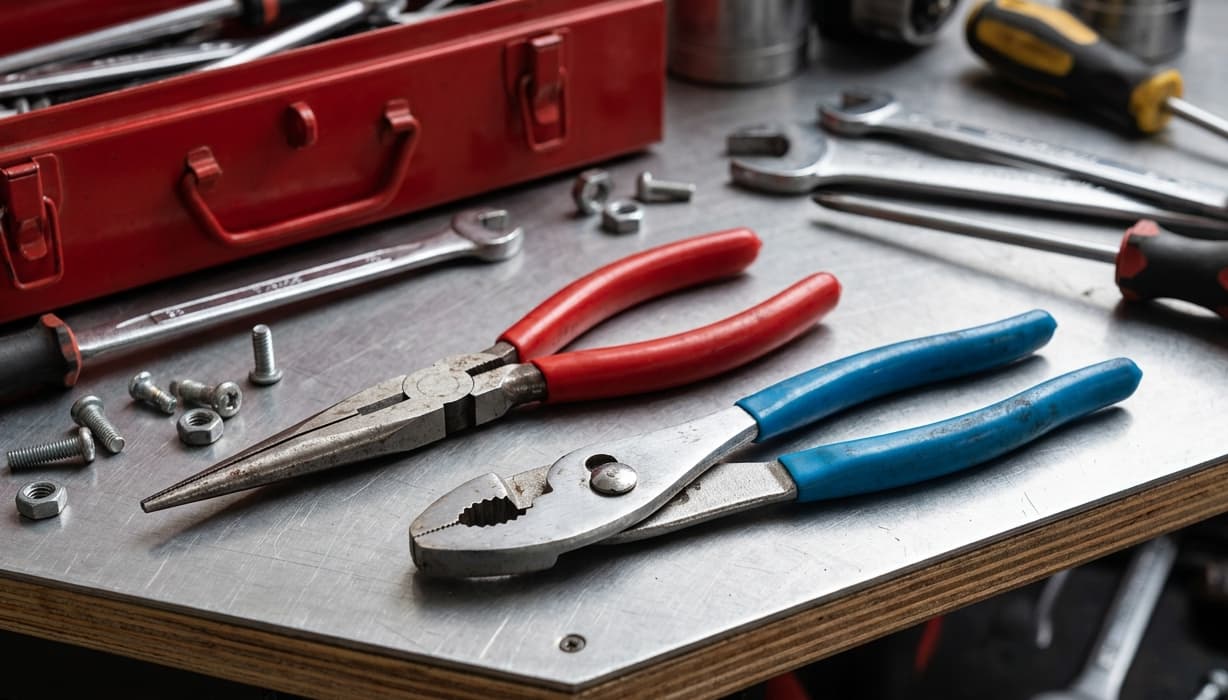

🔧 Needlenose & Slip Joint Pliers: The Ultimate Technical Guide
Everything a professional (or serious DIYer) needs to know — mechanics, history, part numbers, failure modes, maintenance schedules, and buying intelligence — all in one place.
📖 What Are We Talking About Here — Needlenose and Slip Joint?
Ask any seasoned mechanic, electrician, or plumber to empty their tool belt and two items will appear almost universally: a pair of needle-nose pliers and a set of slip joint pliers. These are not redundant tools — they solve entirely different mechanical problems despite both belonging to the pliers family. Understanding what each one actually is, how it works at an engineering level, when to use it, and critically when not to use it, is what separates competent tradespeople from frustrated weekend warriors stripping bolts in a driveway.
Both designs trace their lineages to 19th-century forging traditions, yet both are still being iterated on by manufacturers like Klein Tools, Knipex, Channellock, and Irwin today — a testament to their enduring mechanical elegance. Let’s crack them open completely.
📊 At-a-Glance Spec Snapshot
Needle-Nose Jaw Angle
25–35°Typical taper from pivot to tip for standard long-nose variants
Slip Joint Range
0.5 – 1.75″Typical jaw-opening span across the two pivot positions
Mechanical Advantage
~3:1 – 5:1Force amplification at the jaw vs. hand grip force
Hardness (Jaw Teeth)
55–62 HRCRockwell Hardness C-scale for induction-hardened jaw serrations
Insulated Rating
1,000 V ACVDE-rated variants (EN IEC 60900) for live electrical work
Common Length Range
4″ – 12″From fine jeweler’s needle-nose to heavy utility slip joints
🪡 Needle-Nose Pliers — Deep Mechanical Dive
Needle-nose pliers (also called long-nose pliers, snipe-nose pliers, or radio pliers) are defined by a tapered, elongated jaw that converges to a relatively narrow gripping surface at the tip. The defining characteristic is geometry — the jaw extends significantly beyond the rivet pivot, maximising reach into confined spaces where standard flat-nose or combination pliers cannot physically fit.
The pivot mechanism is a single cold-formed rivet (typically 4–6 mm diameter in forged chrome-vanadium versions) that holds both forged halves together. High-quality pairs use a box-joint construction — where one jaw wraps around the other — providing dramatically superior side-load resistance over cheaper lap-joint designs. When examining a pair, try to flex the jaws laterally: more than 0.5 mm of side play indicates a worn or under-spec rivet, which causes jaw misalignment and poor holding torque.
Most needle-nose pliers incorporate a wire cutter — a hardened shearing edge positioned just behind the pivot. These cutters are induction-hardened to approximately 58–62 HRC and are designed to shear copper wire cleanly without flattening. The cutter’s geometry is bevelled on one side (the “dead” side) and flat on the other to produce a clean cut face. A common failure mode is chipping of these edges when pliers are misused to cut hardened steel or spring steel — always check part specifications before cutting anything above 40 HRC.
Hold the pliers up to a light source with jaws closed. Any visible light gap along the serrated faces indicates jaw misalignment — likely caused by rivet wear (P/N varies by brand; Knipex replacement rivets for their 08 series are P/N 91 99 250). Misaligned jaws dramatically reduce grip force and can cause workpiece slippage — dangerous when working with small electronic components or live wire.
🔩 Common Needle-Nose Sub-Types & Their Applications
🔵 Standard Long-Nose (4″–8″): Electronics assembly, jewellery work, pulling wire through conduit. 🟠 Bent-Nose (45° or 90°): Reaching around obstacles in engine bays or PCB rework without obstructing sight lines. 🟢 Round-Nose: Forming wire loops and coils — the cylindrical jaws prevent flat spots that standard serrated jaws would create. 🟣 Extra-Long Reach (12″+): HVAC coil work, pulling wires through deep wall cavities.
🔄 Slip Joint Pliers — Engineering & Mechanism Explained
Slip joint pliers earn their name from a fundamentally different pivot design: instead of a fixed rivet, one jaw contains an elongated slot — the slip joint channel — through which the connecting pin (a hardened flat-head rivet or bolt) can slide between two or more discrete positions. This lets the user reposition the pivot point relative to the jaw, effectively changing the jaw opening range without picking up a different tool.
In the closed position, the pivot sits at the narrow end of the channel — ideal for gripping smaller objects (bolts, pipe fittings, wire bundles) in the 3–18 mm range. Moving the pivot to the open position shifts the jaw spread by approximately 8–15 mm depending on the tool length, accommodating larger-diameter workpieces like copper pipe sections, chrome bath fittings, or hex-head bolt clusters.
The slip joint mechanism is mechanically simpler than the multi-position tongue-and-groove (Channellock) design popularised in the 1930s, which is technically a groove joint or water pump pliers design — often incorrectly called slip joints. True slip joint pliers have only two pivot positions, distinguishing them from their multi-position cousins. This distinction matters for torque ratings: the single-channel slip joint transmits load more concentrically, reducing jaw twist under high clamping loads.
📜 A Brief but Fascinating History
The pliers form traces directly to blacksmith tongs used since at least 3000 BCE, but precision-forged steel pliers as workshop tools emerged in the mid-1800s alongside industrialisation and the need to manipulate telegraph and electrical wiring. The first needle-nose variants were likely adapted from watchmaker’s and jeweller’s tools — the “snipe nose” designation appears in English tool catalogues from the 1870s.
The slip joint mechanism was refined and standardised in the late 19th century, appearing prominently in American hardware catalogues by the 1880s. Companies like Walden, Russell and Irwin (later Irwin Tools) produced large volumes for the growing railroad, telegraph, and plumbing industries. The introduction of drop forging with chrome-vanadium steel (Cr-V, ASTM A681 equivalent) in the early 20th century transformed durability — prior pliers used wrought iron or low-carbon steel, which wore rapidly and bent under load.
The modern era belongs to induction hardening, precision CNC grinding of jaw profiles, and ergonomic bi-material grips. Knipex (Germany), founded in 1882, remains the benchmark for precision needle-nose construction. Channellock (USA, est. 1886 as Champion-DeArment Tool Co.) defined the groove-joint standard, while Klein Tools (USA, est. 1857) dominates the North American electrical trade market.
🛠️ Maintenance & Inspection Schedule — Technical Reference
| Component | Inspection Interval | Failure Indicator | Action | Type |
|---|---|---|---|---|
| Pivot Rivet / Pin | Every 3 months (heavy use) | > 0.5mm lateral jaw play | Replace rivet or retire tool | Both Types |
| Jaw Serrations | Monthly visual check | Rounded tooth peaks, shiny wear faces | Dress with needle file or replace | Slip Joint |
| Wire Cutter Edge | Every 6 months or after misuse | Chipped edge, torn wire cuts | Professional regrind or replace | Needle-Nose |
| Slip Channel / Slot | Monthly — clean & lube | Stiff positioning, visible wear groove | Clean with solvent, apply machine oil | Slip Joint |
| Spring (if present) | Every 6 months | Weak or no automatic opening | Replace spring (most are user-replaceable) | Both Types |
| Grip / Handle Insulation | Before every use (electrical) | Cracks, cuts, delamination, swelling | Retire immediately — no repair acceptable | Both Types |
| Overall Corrosion / Rust | After wet-environment use | Surface pitting, red oxide deposits | Wire brush, WD-40 flush, light oil coat | Both Types |
Never use WD-40 as a long-term lubricant — it’s a water displacing solvent that evaporates and leaves minimal film protection. For pivot joints, apply a single drop of ISO VG 32 machine oil or a PTFE-based dry lubricant (such as Tri-Flow TF21010). Work the pivot 10–12 times to distribute. For slip channels, a light smear of white lithium grease provides excellent wear resistance and doesn’t attract grit the way oil does.
⚠️ Common Failure Modes — With Part References
Understanding how these tools fail prevents dangerous mid-job surprises and informs smart buying decisions.
🔴 Jaw Misalignment (Both Types): The number-one failure in budget pliers. Caused by rivet wear or insufficient rivet head diameter. In Knipex 08 22 145 (5.75″ needle-nose), the rivet assembly is P/N 91 99 250 and is field-replaceable with basic tools. In most consumer-grade tools, internal rivet replacement is not practical — consider the tool spent.
🟠 Cutter Chipping (Needle-Nose): Cutting hardened wire, nails, or spring steel shatters the induction-hardened cutter edge. The cutter zone on high-end pairs like Klein 2007 (7″ D203-7) is factory-hardened as a separate zone from the jaw body. Regrinding requires a diamond wheel and precise angle matching — generally a shop repair, not field repair. Budget: $15–25 for professional regrind vs. $25–50 for quality replacement.
🟡 Slip Channel Galling (Slip Joint): Repeated dry cycling of the slip joint under load causes metal-to-metal galling in the channel slot. The pin cold-welds microscopically to the channel edges, making position changes difficult or impossible. Stanley 84-108 (8″ slip joint) uses a phosphate-coated pin that resists galling well; lower-end variants do not. Once galling occurs, the channel must be dressed with a fine flat file before lubrication.
🟣 Handle Delamination: Bi-material grips (hard PP core + soft TPR overmould) can separate at the bonding interface after exposure to petroleum solvents (WD-40 pooling under the grip, carb cleaner spray). OSHA 1910.303(g)(1) regulations require undamaged insulation on tools used near energised conductors — delamination is an automatic retirement trigger. Replacement grips are available for major brands: Knipex T01 grip series, Klein 94 AA series.
⚖️ Needlenose vs. Slip Joint — Honest Pros & Cons
🪡 Needle-Nose Pliers
✅ Advantages
- Unmatched reach into confined, tight spaces
- Precision grip on small components (wire ends, pins, terminals)
- Integrated wire cutter adds multi-function value
- Available in VDE 1,000V rated versions for live electrical work
- Round-nose variants form wire loops cleanly
- Lightweight — reduces hand fatigue in repetitive tasks
❌ Limitations
- Low clamping force — thin jaw cross-section bends under high torque
- Cannot grip large-diameter pipe or hex fasteners adequately
- Tip is fragile — misuse as a pry tool cracks or bends jaw tips
- Wire cutter chips if used on hardened steel
- Poor mechanical advantage for stubborn fasteners
🔄 Slip Joint Pliers
✅ Advantages
- Versatile jaw range covers both small & medium workpieces
- Higher clamping force due to shorter, stouter jaw geometry
- Durable — tolerates moderate over-torque without jaw deformation
- Excellent for plumbing slip nuts, chrome bathroom fittings
- Widely available; very affordable at quality tier
❌ Limitations
- Only two jaw positions — less versatile than groove joint variants
- Jaw serrations mark soft metals (aluminium, brass, chrome)
- Cannot access recessed or deep-cavity fasteners
- Slip channel wears without regular maintenance
- Not suitable for precision electronics work
💰 Market Value & Buying Intelligence
The pliers market has three clear tiers, and understanding them prevents both overspending and underbuying.
🟢 Budget Tier ($5–$18): Brands like Hyper Tough, Pittsburgh (Harbor Freight), and generic imports. These use lower-grade carbon steel (not Cr-V), lap-joint construction rather than box-joint, and frequently exhibit >1mm jaw play out of the box. Suitable for very occasional household use only. Not recommended for professional or frequent use — jaw misalignment develops rapidly.
🟡 Mid-Range Tier ($18–$45): Irwin Tools Vise-Grip, Stanley FatMax, Klein Tools D203 and D511 series. These use chrome-vanadium (Cr-V) steel, machine-ground jaw surfaces, and better heat treatment. Klein D203-8 (8″ needle-nose, ~$22) and the Stanley 84-108W (8″ slip joint, ~$14) represent exceptional value in this category and are genuine professional-grade tools.
🔴 Professional / Premium Tier ($40–$120+): Knipex (Germany) dominates this space. The Knipex 08 22 145 (5.75″ long-nose, ~$38) and Knipex 82 01 250 (10″ slip joint, ~$55) are the industry benchmarks. These feature oil-hardened, mirror-polished jaw faces, optimised rivet tolerances of ±0.01mm, and ergonomic DIN EN ISO 9001 certified manufacturing. For daily professional use, the cost-per-use economics strongly favour this tier.
🎯 When to Reach for Which Tool
⚡ Reach for needle-nose when: routing wire through junction boxes, bending wire connectors, holding small components during soldering, retrieving dropped screws from deep recesses, forming wire loops for terminal connections, or any task where the geometry of the work cavity demands a narrow tool profile.
💧 Reach for slip joint when: tightening or loosening plumbing slip nuts, gripping a nut while torquing a bolt, bending sheet metal edges, turning stubborn screwed-in aerator screens on faucets, or any general gripping task requiring moderate to firm clamping on objects from 5mm to 40mm diameter.
🚫 Never use either tool: as a hammer, as a wrench substitute on hex fasteners (use the correct spanner/socket to avoid rounding), as a pry bar, or on live electrical systems without VDE-rated insulation confirmed visually.
❓ Frequently Asked Questions
-
What is the main difference between needlenose and slip joint pliers?
Needle-nose pliers feature a tapered, elongated jaw designed for reaching confined spaces and gripping small objects with precision. Slip joint pliers have a stouter jaw with an adjustable pivot — a slotted channel allowing two jaw-opening positions — suited for gripping larger objects with more clamping force. They solve different problems: needle-nose for finesse and reach, slip joint for versatile clamping strength.
-
Can slip joint pliers be used for plumbing?
Yes, slip joint pliers are commonly used for basic plumbing tasks such as tightening and loosening slip nuts on P-traps, aerators, and supply line connections. However, for larger diameter pipe work or high-torque applications, groove joint (tongue-and-groove) pliers like Channellock provide more grip positions and better mechanical advantage. Protect chrome or soft metal fittings by wrapping the jaws with electrical tape or cloth.
-
Are needle-nose pliers safe for electrical work?
Standard needle-nose pliers are NOT safe for working on live circuits. For electrical work on energised conductors, you must use VDE-rated insulated pliers (conforming to EN IEC 60900) marked with the double-triangle symbol and rated to 1,000V AC / 1,500V DC. Examples include Knipex 08 22 145 VDE or Klein D203-8-EINS. Always visually inspect the insulation before each use — any crack, cut, or delamination means immediate retirement.
-
Why do my needle-nose pliers leave marks on soft metal?
The serrated jaw faces (cross-hatched teeth at 55–62 HRC) are designed to bite into workpieces for grip — which is excellent on steel but damages aluminium, brass, copper, and chrome. To prevent marring, wrap the jaw teeth with two layers of electrical tape (changed regularly as it wears), use commercial jaw protectors (rubber or plastic slip-on caps available from Knipex and Klein), or use smooth-jaw (non-serrated) pliers for decorative or soft-metal work.
-
What’s the difference between slip joint pliers and Channel-Lock pliers?
“Channel-Lock” is a trademarked brand name that has become synonymous with groove joint pliers (technically also called tongue-and-groove or water pump pliers). True slip joint pliers offer exactly two pivot positions via a linear slot. Groove joint (Channel-Lock style) pliers offer 5–7 positions via interlocking tongue-and-groove serrations on the pivot area, allowing a much wider jaw adjustment range. The Channellock 420 (12″, adjustable from 0″ to 2.5″) is a classic groove joint example — not a slip joint despite common misuse of the term.
-
How long should quality pliers last?
Premium Cr-V pliers from manufacturers like Knipex or Klein, used correctly and maintained per the schedule above, routinely last 15–25 years in professional daily use. The limiting factors are cutter edge wear (needle-nose), slip channel galling (slip joint), and grip insulation degradation. Budget tools typically show meaningful jaw wear within 12–18 months of regular use. The cost-per-year economics strongly favour the premium tier for professionals.