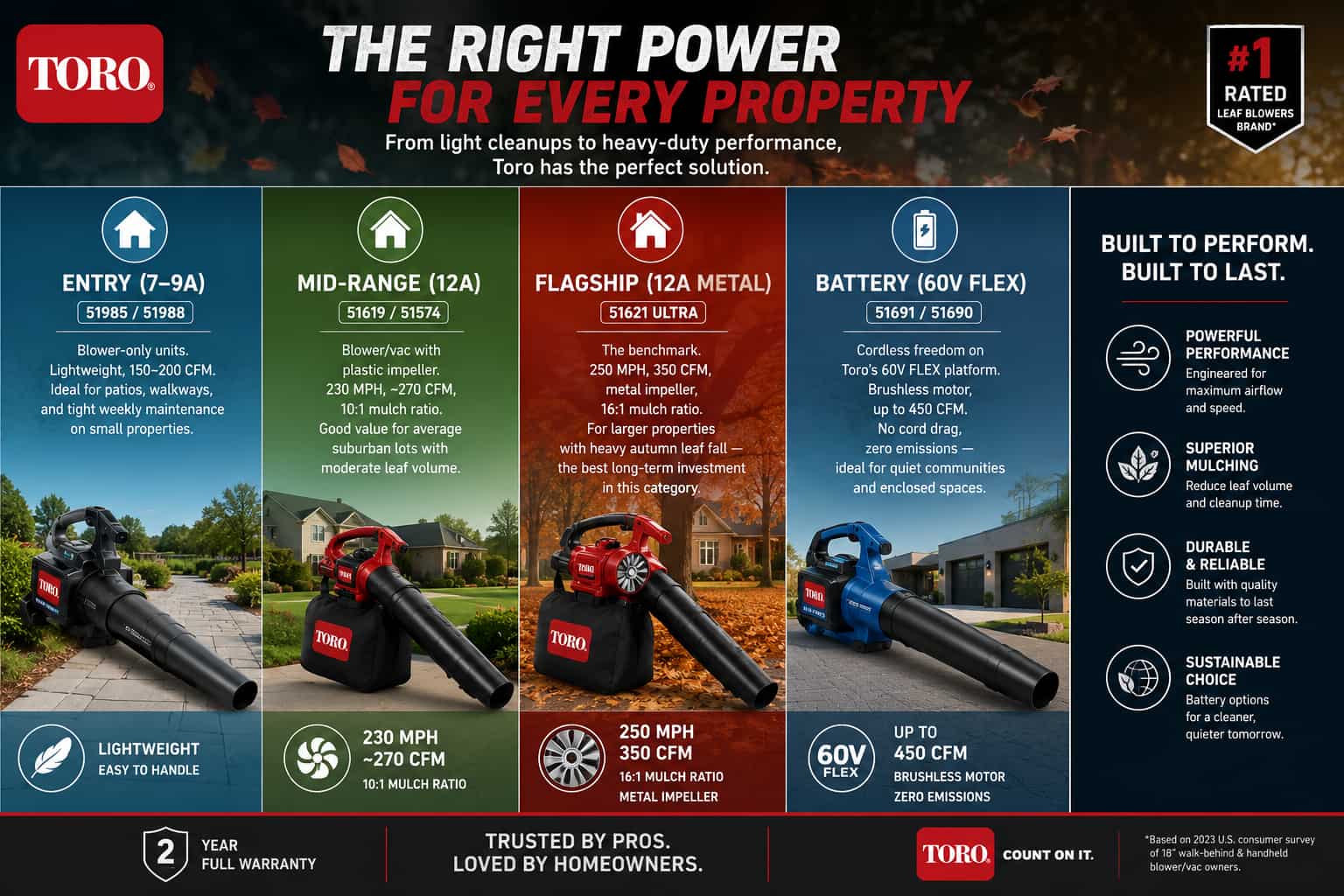

🍂 Toro Leaf Blower: The Complete Technical Guide — Specs, Parts, Vacuum Conversion & Expert Maintenance
Master every dimension of your Toro leaf blower — from core performance metrics and critical part numbers to step-by-step vacuum conversion, seasonal maintenance, and where to buy at the best value.
🌀 Why Toro Dominates the Leaf Blower Category
When it comes to outdoor power equipment, few names carry the engineering credibility of Toro. Founded in Minneapolis and built over a century of relentless product refinement, Toro has earned a reputation that spans professional landscaping crews, municipal parks departments, and millions of homeowners who demand real performance from their yard tools. Their leaf blower lineup is the clearest expression of that philosophy: functional, powerful, and built with a dual-purpose design that turns a single machine into a complete yard cleanup system.
What separates Toro’s blowers from commodity alternatives is not merely horsepower or airflow figures on a spec sheet — it is the integrated blower/vacuum/mulcher architecture that compresses leaves at ratios of up to 16:1 before collection. That means 16 bags worth of loose leaves becomes one compact bag of mulch, ready for composting or curbside disposal. For homeowners with deciduous trees, that efficiency is transformative.
This guide covers every critical dimension of Toro leaf blowers: performance data, the anatomy of the flagship Toro 51621, genuine part numbers for common repairs, a precise conversion walkthrough, optimal operating technique, seasonal maintenance protocols, and honest pros and cons. Whether you already own a Toro or are evaluating your first purchase, this is your definitive technical reference.
⚡ Core Performance Metrics: Toro Ultra Blower/Vac 51621
The performance of any leaf blower is measured by three primary variables: airspeed (MPH), air volume (CFM), and motor amperage. The Toro 51621 leads the corded electric category on all three, while its metal impeller pushes mulch efficiency to a class above.
🔬 Toro 51621 Deep Dive: Engineering the Benchmark
The Toro 51621 — marketed as the Ultra Blower/Vac — occupies the performance apex of Toro’s corded electric lineup. It is the machine that established what “electric leaf blower performance” should look like, and it has held that benchmark through successive iterations without fundamental design compromise.
🔩 Metal Impeller: The Core Differentiator
At the heart of the 51621’s superiority is its metal (aluminum alloy) impeller. Competing models at similar price points almost universally use injection-molded plastic fan blades, which are lighter but dramatically less durable and far less effective at mulching. The metal impeller in the 51621 accomplishes three things plastic cannot match: it survives incidental contact with stones or wire staples without shattering, it generates the cutting force necessary for 16:1 mulch reduction, and it maintains rotational balance over thousands of hours of use. When a plastic impeller cracks, the unit vibrates and performance collapses immediately. A metal impeller with minor surface damage continues performing without degradation.
🎛️ Variable-Speed Control
The 51621 uses a true variable-speed rotary dial rather than the simple two-position high/low switch found on cheaper models. This is a far more meaningful feature than marketing copy suggests. At low speeds (roughly 100–130 MPH), the blower becomes a precision tool for clearing flower beds, patio gaps, and garage interiors without launching lightweight objects. At 80% throttle, it handles standard dry-leaf removal efficiently while reducing motor heat. Full throttle is reserved for wet or matted material that requires maximum force.
| 📋 Specification | Detail | Rating |
|---|---|---|
| Model | Toro 51621 Ultra Blower/Vac | Flagship |
| Motor Type | 12-Amp Induction, AC | Excellent |
| Max Airspeed | 250 MPH (Variable) | Best-in-Class |
| Max Air Volume | 350 CFM | Excellent |
| Impeller Material | Aluminum Alloy (Metal) | Premium |
| Mulch Reduction | 16:1 | Industry-Leading |
| Speed Control | Infinite Variable Dial | Precise |
| Collection Bag | 1.5 Bushel / Bottom-Zip | Convenient |
| Cord Retention | Built-in Hook System | Reliable |
| Noise Level | ~70–75 dB at 50 ft | Neighbor-Friendly |
| Extension Cord | Not included — 14-gauge min. required | User Supplied |
| Operating Weight | ~8.5 lbs | Manageable |
Always use a 14-gauge (or heavier) outdoor-rated extension cord with the 51621 — never 16-gauge. Undersized cords cause significant voltage drop across the wire length, robbing the motor of power, generating excess heat, and repeatedly triggering the thermal cutout. For cord runs beyond 100 feet, upgrade to 12-gauge. The cord should carry the “W-A” or “SJTW” outdoor rating and a grounded 3-prong connector. This single precaution prevents the majority of performance complaints associated with this model.
🔌 Toro Electric Leaf Blower Lineup: Which Model Fits Your Yard?
Toro’s electric blower range covers a broad performance spectrum. Matching the right model to your specific yard conditions and task frequency is the foundation of a good purchasing decision.
The core decision matrix: corded vs. battery (battery wins on mobility; corded wins on sustained power and cost), and blower-only vs. blower/vac (the 51621’s vacuum/mulch capability pays back in every autumn cleanup session for properties with deciduous trees). For anything beyond a quarter-acre lot with significant canopy, the 51621 is the clear corded-electric recommendation.
🔄 How to Convert Your Toro Leaf Blower to Vacuum Mode
Toro’s tool-free conversion system is one of its most celebrated engineering features, yet surveys consistently show that a significant portion of blower/vac owners never use the vacuum mode — simply because they’re unsure how to make the switch correctly. Here is the precise, step-by-step process:
-
1🔌 Disconnect Power Completely Unplug the cord from the wall outlet. Never convert between modes while the unit is energized. Set the blower on a flat, stable surface and wait 3–5 seconds for the impeller to fully stop spinning before handling.
-
2🔧 Remove the Blower Tube Assembly Grip the blower tube at its connection collar. Rotate counterclockwise (or depress the release tab on your specific variant) and pull straight away from the body. Set both tube sections aside — you’ll need them when returning to blower mode.
-
3🔀 Flip and Reorient the Housing On the 51621, the main body must be rotated 180 degrees so the air outlet becomes the vacuum inlet. Locate the alignment ridges on the housing — these ensure correct airflow orientation. The motor housing grip will now sit on the opposite side from blower mode.
-
4🪣 Attach the Vacuum Intake Tube Take the dedicated vacuum tube (the wider, flared tube with the curved lower section included in the original box). Align it with the intake port, push firmly, and rotate clockwise until you feel a solid click. Perform a short tug test — if it pulls free easily, it is not fully seated. The curved lower section positions the intake mouth at the correct ground-sweeping angle.
-
5🎒 Mount the Collection Bag Slide the collection bag’s open end over the exhaust port (the air outlet of the impeller housing). Engage the locking tabs and ensure the bottom zipper is fully closed before operation. The Toro bottom-zip design allows emptying mulched material without removing the bag from the unit — a significant time-saver during high-volume sessions.
-
6✅ Confirm, Connect, and Test Shake the unit gently — all connections should feel solid with no rattle. Hold at a comfortable 30–40 degree downward angle. Plug in and start at low speed. A whistling sound at any connection point signals an incomplete seal. Investigate before increasing speed. Once sealed, a low hum and strong suction airflow confirms correct assembly.
In vacuum mode, use slow, deliberate half-arc sweeps rather than rapid back-and-forth passes. The 16:1 mulch ratio is achieved when leaves enter the intake at a steady rate — forcing a large clump of wet material into the tube at once overloads the impeller and bogs the motor. For wet or rain-damp leaves, operate at 80–85% throttle to maintain consistent mulch quality and prevent the collection bag from becoming saturated with moisture.
🎯 How to Use a Toro Leaf Blower Vacuum: Optimal Technique
Owning a high-performance Toro blower/vac is only half the equation — systematic operating technique determines whether yard cleanup takes one hour or three. Most users default to random full-power blowing followed by improvised vacuuming. A structured two-phase approach cuts total task time by 30–40% and extends the life of the impeller and collection bag.
🍂 Phase 1 — Blow First, Consolidate Strategically
Always begin in blower mode. Work the perimeter of each zone inward in overlapping arcs — the “rim-to-center” technique. Use the prevailing wind to your advantage: position yourself so the wind assists rather than opposes leaf movement. Aim to consolidate all leaves from a given zone into one central pile before switching to vacuum mode. Do not attempt to vacuum leaves as they fall or while widely distributed — the blower moves 10× the volume in the same time the vacuum can collect it.
🧭 Phase 2 — Vacuum from the Upwind Side
After converting to vacuum mode, always approach consolidated piles from the upwind side. This means the slight ambient airflow draws surface leaves toward the vacuum intake naturally, rather than pushing lighter leaves away from the tube mouth. Maintain the intake approximately 2 to 3 inches above the ground for optimal suction without picking up soil, pebbles, or debris that could damage the impeller.
🗂️ Phase 3 — Bag Management
Monitor bag fullness by feel — a full bag creates audible backpressure that slightly reduces motor efficiency. The 16:1 mulch ratio means that roughly 24 bushels of loose leaves compress into 1.5 bushels of mulch. Empty the bag when approximately 70–80% full rather than waiting for complete capacity, as overfull bags strain the zipper assembly. Mulched output can go directly into a compost bin, eliminating the need for separate compost bags.
🔩 Toro Leaf Blower Parts: Replacements, Part Numbers & Failure Patterns
Understanding the component architecture of your Toro blower/vac — and maintaining a reference list of critical part numbers — is essential for fast, cost-effective maintenance. Below are the most commonly replaced components for the Toro 51621 and related models, with part numbers and diagnostic guidance:
The most critical wear component. Signs: vibration during operation, rattling sounds, reduced suction power. Replace immediately if any blade is bent or chipped. Always wear cut-resistant gloves when handling.
Replace when fabric tears near the zipper seam or when bag structure collapses under mulch weight. Degraded bags allow fine dust to escape, causing the “blowback” complaint many users experience.
Cracks most commonly occur at the connection flange after repeated thermal cycling. Check the locking tab condition each season — worn tabs cause false-seated connections and air leaks.
Focuses airflow into a tight, high-velocity stream for gutter clearing and precision work. Frequently misplaced — store it in the collection bag when not in use to prevent loss.
The small plastic loop that secures the extension cord to prevent accidental disconnection mid-task. High failure rate due to UV degradation — inspect annually and replace proactively before a session failure mid-yard.
Two-section blower tube assembly. Connection points crack after many seasons of thermal expansion/contraction cycles. Both sections are available individually — partial replacement is usually sufficient.
Wide, low-profile nozzle that distributes airflow across a broader area. Optimal for open lawn areas, large driveways, and moving high-volume dry leaf accumulations efficiently.
Self-tapping housing screws are frequently stripped during amateur disassembly. Always use a hand-turned Phillips #2 or Torx T20 driver — never an impact driver on these small-diameter, thin-walled bosses.
The single most reported failure on the Toro 51621 is impeller damage from hidden debris in leaf piles. Stones, wire staples, thick acorn clusters, metal ground stakes, and garden wire can all contact the metal impeller at thousands of RPM. Before vacuum-processing any leaf pile, spend 15 seconds scanning for large foreign objects and remove them manually. This single precaution routinely extends impeller service life by 3–5 complete autumn seasons.
⚖️ Toro Leaf Blower Pros & Cons: An Honest Assessment
No tool is the right choice for every user. Here is an honest, performance-grounded evaluation of where Toro blower/vacs excel and where their design involves genuine trade-offs:
✅ Strengths
- Industry-leading 16:1 mulch reduction with metal impeller
- True infinite variable-speed dial — not a simple high/low switch
- Best-in-class 250 MPH / 350 CFM for corded electric category
- Tool-free blower-to-vacuum conversion in under 60 seconds
- Metal impeller dramatically outlasts plastic competitors
- Bottom-zip bag allows emptying without bag removal
- No fuel mixing, zero emissions, instant-start every time
- 70–75 dB noise level is genuinely neighbor-friendly
- Wide spare parts availability via dealer network and online
- Strong brand warranty support and service reputation
❌ Limitations
- Corded design limits operational radius to extension cord length
- Heavier in vacuum configuration than blower-only models
- Collection bag needs frequent emptying during heavy leaf fall
- Wet, matted leaves require multiple passes and reduce efficiency
- Power cord and heavy-gauge extension cord not included
- Cord management is cumbersome on irregular or very large properties
- Not sized for commercial or estate-scale properties
- Concentrator nozzle reduces overall airspeed in longer tube configs
🛠️ Seasonal Maintenance Schedule for Toro Leaf Blowers
Electric blowers demand far less maintenance than gas-powered equivalents, but a disciplined seasonal service routine extends motor life, preserves peak performance, and prevents the majority of common failures before they occur. Follow this schedule precisely:
| 📅 Service Interval | 🛠️ Maintenance Task | Tools Needed | ⏱️ Est. Time |
|---|---|---|---|
| After Every Use | Clear impeller housing of leaf debris and trapped moisture | Soft brush, compressed air | 5 min |
| After Every Use | Empty and fully shake out collection bag | None | 2 min |
| Monthly (Active Season) | Inspect all tube connection points for stress cracks | Visual + flex test | 5 min |
| Monthly | Check cord retention hook for UV cracking | Flex test by hand | 2 min |
| Pre-Season | Full impeller inspection — chips, bends, balance check | Flashlight, gloves | 10 min |
| Pre-Season | Thermal cutout test: run at full power for 5 continuous minutes | Stopwatch | 10 min |
| Pre-Season | Clean all motor housing air vents with compressed air | Compressed air can | 5 min |
| Annual | Full disassembly, housing screw re-torque, seal inspection | Phillips #2, Torx T20 | 30–45 min |
| Annual | Deep-clean collection bag (machine wash, cold/gentle cycle, line dry) | Washing machine | Overnight dry |
| Annual | Impeller shaft bearing lubrication (model-dependent) | Light machine oil | 10 min |
Before end-of-season storage, run the blower at full throttle for 2–3 minutes to expel residual moisture from the motor housing and impeller cavity. Store in a dry, UV-protected indoor location — direct sunlight accelerates ABS plastic degradation and connection tube fatigue. Hang the collection bag separately on a hook to prevent permanent creasing of the bag structure. A crushed bag reduces effective collection volume significantly by the following season.
🛒 Where to Buy a Toro Leaf Blower: Best Purchasing Channels
Toro products are distributed through a robust multi-channel retail network. The right channel depends on what you prioritize: price, immediate availability, warranty assurance, or parts access post-purchase.
Widest in-store Toro selection. Seasonal promotions and open-box models at 15–30% off. In-store returns accepted. Often has display models for pre-purchase handling.
Strong price-match policy. Frequently includes bundle deals with extension cords. Good for comparing corded vs. battery models side-by-side in person.
Competitive pricing with fast delivery. Buy from Amazon directly or Toro-authorized sellers only — third-party sellers can affect warranty validity. Check seller ratings carefully.
Manufacturer-direct purchase guarantees full warranty, genuine parts access, and enrollment in Toro’s owner service and technical support network. Best for premium model purchases.
Local dealer network with personalized service. Particularly valuable for parts ordering and warranty coordination. May carry regionally-specific stock and dealer exclusives.
Best for parts sourcing on older units and budget buyers seeking used/refurbished tools. Carefully inspect impeller condition in photos. No warranty — factor accordingly.
❓ Toro Leaf Blower FAQ: Expert Answers to the Most-Asked Questions
The defining difference is the impeller material. The 51621 Ultra features a metal (aluminum alloy) impeller delivering a 16:1 mulch ratio, while the 51619 uses a plastic impeller achieving approximately 10:1. The 51621 also delivers 250 MPH airspeed versus the 51619’s 230 MPH, and demonstrates meaningfully better durability over multi-season use. For homeowners with significant leaf volume and large deciduous tree canopy, the 51621’s metal impeller fully justifies the modest price premium.
No. Vacuum/mulch capability is specific to models explicitly labeled “Ultra Blower/Vac” or “Blower/Vacuum/Mulcher” in the product title. These include the 51619, 51621, and select 60V FLEX battery models. Entry-level blower-only models such as the 51985 have no vacuum conversion capability — they do not include the vacuum tube, collection bag, or the housing geometry needed for mode conversion. Always confirm “blower/vacuum/mulcher” in the specification before purchasing if dual-function operation is a requirement.
Automatic mid-session shutdown is almost always the thermal overload protection activating due to motor overheating from insufficient power delivery or restricted airflow. The primary causes, in order of frequency: (1) undersized extension cord (16-gauge or lighter) causing voltage drop and heat buildup, (2) cord runs exceeding 100 feet without upgrading to 12-gauge wire, (3) a blocked impeller housing restricting the airflow needed for motor cooling, (4) an overfull collection bag creating exhaust backpressure. Resolve cord gauge first, then inspect for any blockage in the impeller path.
Fine dust escaping through the collection bag indicates one of two conditions: the bag fabric has developed micro-tears or pinholes (hold it up to a light source in a darkened space to identify them), or you are vacuuming very fine, dry material — sawdust, peat, or fine sand — that passes through the bag weave regardless of its condition. Replacement bags with tighter-weave fabric (Part 127-7030) resolve degradation issues. For inherently fine materials, wear eye protection and a dust mask regardless of equipment quality.
0–50 feet: minimum 14-gauge, outdoor-rated (“SJTW” or “W-A” marked) with grounded 3-prong connector. 50–100 feet: 12-gauge required. Over 100 feet: 10-gauge heavy-duty cord. Never use 16-gauge cords with a 12-amp motor — the voltage drop is significant enough to cause both performance degradation and thermal overload events. Cord gauge is the most impactful single variable in corded-electric leaf blower performance, and it is the most commonly ignored recommendation in the user manual.
Genuine Toro parts are available through four channels: (1) Toro.com — the manufacturer’s parts portal with full model cross-referencing and part-number lookup; (2) Authorized Toro dealers — locatable via the dealer-finder on Toro’s website; (3) Home Depot and Lowe’s — carry high-turnover parts (bags, tubes, nozzles) in-store; (4) Parts lookup sites such as eReplacementParts.com and Partstree.com — excellent for exploded-view diagrams when you need to visually identify an unknown component. Always order by part number to eliminate compatibility errors.
Yes, with the concentrator nozzle (Part 127-7031), which narrows the airflow into a high-velocity precision stream well-suited to gutter debris removal. Third-party gutter cleaning kits with extended curved tubes that connect to standard Toro blower tube collars are also widely available and compatible. Important safety note: always operate from ground level using extended tube attachments — never climb to rooftop height with a corded electric blower. Active cord management at elevation creates a genuine fall hazard that no airflow performance benefit justifies.