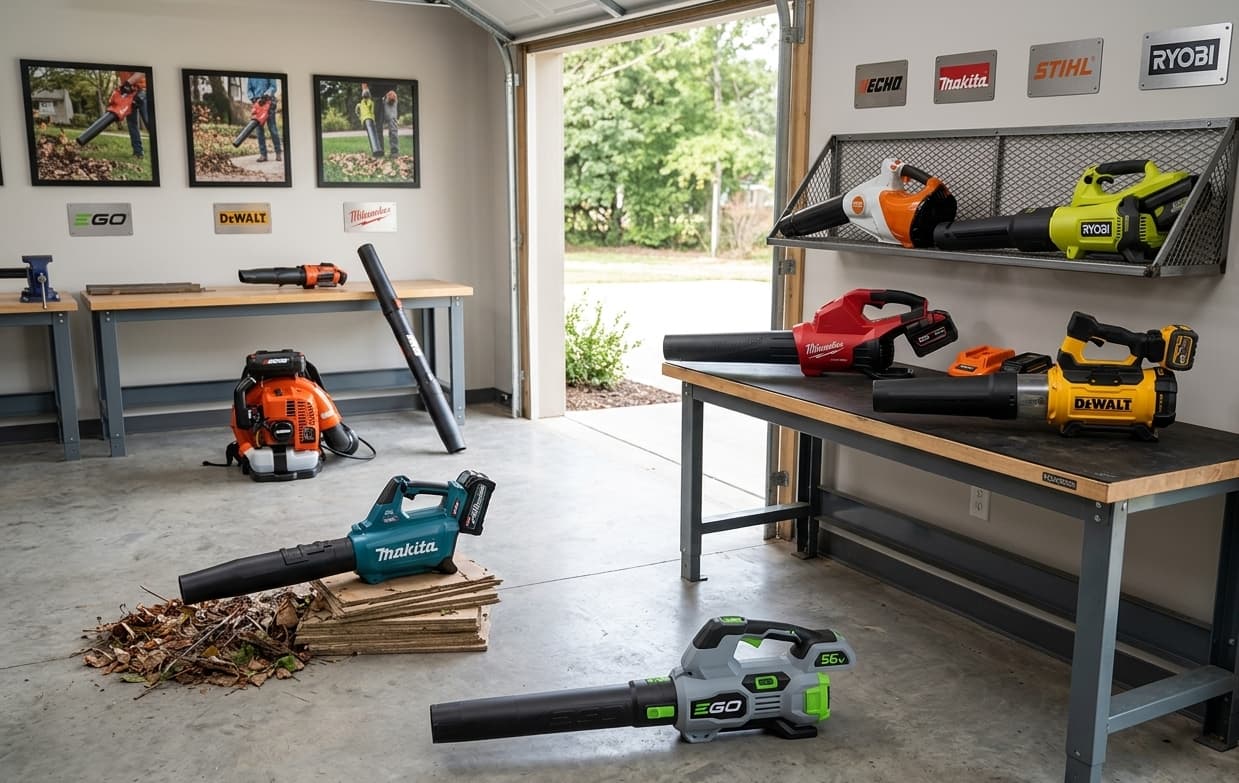

🍂 Best Battery-Powered Leaf Blowers: The Ultimate Cordless Guide for 2026
Everything you need to know about cordless leaf blowers — from brushless motor specs and battery chemistry to common failures, repair part numbers, and pro maintenance routines.
🌿 Why Cordless Leaf Blowers Have Taken Over
Walk into any hardware store in 2026 and you’ll notice something striking: the gas-powered leaf blower aisle keeps shrinking. Battery-powered cordless leaf blowers have completed a decade-long takeover that began humbly with underpowered 18V tools and now culminates in 60V+ monsters that rival professional-grade gas units in raw airflow. The transformation is driven by three forces working simultaneously — lithium-ion battery energy density doubling every six years, brushless motor efficiency hitting north of 90%, and increasingly strict noise and emissions ordinances from California to Connecticut.
Whether you’re managing a modest suburban backyard or a sprawling commercial property, this guide cuts through the marketing noise. We cover the real engineering behind CFM and MPH ratings, how to identify and fix the most common failure points (with part numbers), which battery platforms to commit to, and the maintenance rituals that separate a leaf blower lasting three seasons from one lasting fifteen.
⚡ Key Performance Metrics Explained
Before buying any cordless leaf blower, you need to understand what the numbers on the box actually mean — because marketing frequently conflates “peak” and “sustained” performance.
Marketing departments love to advertise maximum CFM and MPH separately because neither alone tells the full story. The metric engineers care about is Newton force (N), calculated as: CFM × Air Velocity. A blower producing 700 CFM at 130 MPH generates roughly 14–16 N of blowing force — genuinely usable for wet leaves. Anything below 10 N at sustained speed is best limited to light debris on dry days.
🔋 Battery Technology Deep Dive: Lithium-Ion Platforms Compared
The single most important purchase decision with any cordless leaf blower isn’t the tool itself — it’s the battery platform. OEM lithium-ion packs use proprietary Battery Management Systems (BMS) that communicate cell temperature, State of Charge (SOC), and fault codes back to the tool’s ESC (Electronic Speed Controller). Mixing brands will at minimum reduce performance and can trigger thermal shutdowns.
Modern cordless leaf blowers use either 21700 cylindrical cells (higher energy density, common in Greenworks, EGO, Ryobi 40V+) or the older 18650 form factor (DeWalt FLEXVOLT, early Milwaukee M18). The chemistry is almost universally LiNiMnCoO₂ (NMC), offering a balance of energy density and cycle life. LiFePO₄ packs are emerging in a few EGO and Greenworks SKUs — they last 2,000+ cycles vs. the standard 500 cycles of NMC, though at slightly lower energy density.
Flagship SKU: BA2800T (28Ah, 56V)
Max Energy: 1,568 Wh
Charger time (5Ah): ~40 min (Turbo Charger)
Industry-leading energy density. Rapid Charge system uses active balancing during charging to extend longevity.
Flagship SKU: 80V 4.0Ah (GBA80400)
BMS Features: Over-discharge protection at 2.5V/cell
Compatibility: 80V Pro platform (cross-tool)
Offers exceptional value. Cells sourced from Samsung SDI and LG Chem — top-tier manufacturers.
Flagship SKU: 48-11-1870 (7.0Ah)
REDLINK PLUS™: Bidirectional BMS communication
Claimed cycles: 800+ to 80% capacity
Best tool ecosystem if you’re already in M18. The blower (2724-20) delivers 450 CFM in a compact form.
Flagship SKU: DCB612 (12Ah @ 20V / 4Ah @ 60V)
Blower model: DCBL772X1 (125 MPH / 600 CFM)
Unique: Backward compat. with all 20V MAX tools
The dual-voltage architecture is genuinely clever engineering. The FLEXVOLT BMS switches cell groupings electronically.
Flagship SKU: OP40601 (6Ah HP)
Blower model: RY40460 (730 CFM / 190 MPH) Top Performer
Value rating: ★★★★★
The Ryobi 40V platform is the most accessible premium cordless ecosystem — over 80 tools share the same pack.
Flagship SKU: BL4080F (8Ah)
Blower model: GBU01Z (473 CFM / 120 MPH)
Motor type: Brushless AWD (Auto-sense Wind Detect)
Professional-grade build quality. The XGT platform is designed for jobsite durability with IP56 dust/water rating.
⚙️ Brushless Motor Mechanics: Why It Changes Everything
Every premium cordless leaf blower sold in 2026 uses a Brushless DC (BLDC) motor — and the difference vs. legacy brushed motors is not subtle. Brushed motors rely on carbon brushes physically contacting a rotating commutator ring to switch current direction. This creates friction, heat, and inevitable wear. The brushes (typically part numbers like Homelite 308028001 or Black+Decker 90560429-02 in older models) are a consumable with a lifespan of ~100–200 hours.
Brushless motors eliminate all of this. Current switching is handled electronically by the tool’s Electronic Speed Controller (ESC) — a small PCB that reads rotor position via Hall-effect sensors and fires the stator windings at precisely the right moment. The result: 85–92% electrical efficiency vs. 60–75% for brushed units, 50% longer motor life, and dramatically better torque-to-weight ratios. The stator winding in a modern BLDC blower motor (e.g., EGO’s LB6004 uses a 9-pole stator) generates a rotating magnetic field at up to 45,000 RPM.
Look at the tool’s ventilation slots. Brushed motors need larger openings to dissipate heat and allow brush dust to escape — you’ll often see a fine black residue near vents after extended use. Brushless motors run cooler and produce no carbon dust. If your “cordless” blower has brush access ports (small threaded plugs on the motor housing), it’s brushed. In 2026, avoid buying any new brushed cordless leaf blower — the technology is simply obsolete for this application.
⚖️ Cordless Leaf Blowers: Honest Pros & Cons
- Zero exhaust emissions — compliant with CARB and EPA Phase 3 rules
- Instant-start, no choke or primer bulb ritual
- 62–75 dB operation — usable in noise-sensitive neighborhoods
- Minimal maintenance: no spark plugs, air filters, or carburetors
- Battery charges in 30–90 min on rapid chargers
- Multi-tool battery platforms reduce total cost of ownership
- Variable speed triggers allow fine-tuned CFM control
- No fuel mixing, no stale gas degrading a carburetor over winter
- Runtime limited to 15–45 minutes on a single charge at full power
- High-capacity batteries add significant weight and cost
- Proprietary battery platforms create ecosystem lock-in
- Performance degrades as battery depletes (voltage sag)
- Cold weather (below 40°F) significantly reduces battery capacity
- Upfront cost 20–40% higher than equivalent gas models
- Battery pack replacement can cost $80–$250 after warranty
- Not ideal for full-day commercial use without multiple packs
🛠️ Common Failures, Diagnostics & Part Numbers
Battery-powered leaf blowers are dramatically more reliable than gas units, but they’re not failure-proof. Here are the most frequently reported failure modes, with diagnostic steps and specific part numbers where applicable.
| ⚠️ Failure Mode | Symptoms | Root Cause | Part / Fix | Difficulty |
|---|---|---|---|---|
| ESC (Controller) Failure | Tool clicks, no motor spin; LED error flash (3 blinks = overcurrent) | MOSFETs burned by voltage spike; moisture intrusion | EGO: 2902308001; Ryobi: 039012001070 | Moderate |
| Hall Sensor Board Failure | Motor stutters, won’t reach full speed, vibrates badly | Hall-effect IC fails from heat; damaged harness | Universal: 3-sensor board ~$12–$18 (SS41/SS443A ICs) | Moderate |
| Battery Cell Degradation | Runtime drops >40%; tool cuts out under load | NMC cell capacity fade after 300–500 deep cycles | Rebuild with Samsung 21700 50E cells or OEM replacement | Advanced |
| Impeller / Fan Damage | Loud rattling, reduced CFM, vibration increase | Debris ingestion; fatigue cracking in polypropylene | DeWalt: N453481; EGO: LB6002-IP | Easy |
| Trigger Potentiometer Wear | Erratic speed; full-speed only; speed won’t vary | Carbon track wear inside variable-speed pot | 10kΩ linear pot (B10K); Makita part 651086-9 | Easy |
| Battery Terminal Corrosion | Intermittent power loss; pack won’t seat properly | Moisture + electrochemical corrosion on Au-plated contacts | Clean with DeoxIT D5; replace contact springs if pitted | Easy |
| Thermal Shutdown (No Fault) | Tool stops after 10–15 min; restarts when cool | Clogged ventilation duct; ambient temp >104°F (40°C) | Clean vents with compressed air; check NTC thermistor | Easy |
| Tube Latch Breakage | Nozzle tube won’t lock in place; falls off during use | Polycarbonate fatigue at the latch tab from UV exposure | Ryobi: AC80RL3 tube set; EGO: AB2401 | Easy |
Most premium cordless leaf blowers communicate fault states via LED blink patterns. EGO units: 1 blink = low battery; 3 blinks = motor overload; 5 blinks = ESC thermal shutdown. DeWalt FLEXVOLT: The battery LED matrix shows remaining charge AND fault state — hold the button while inserting the pack for diagnostic mode. Always check the manufacturer’s service manual (often available as a PDF on the support portal) before ordering replacement parts.
🔧 Seasonal Maintenance Schedule
Battery-powered leaf blowers need far less maintenance than gas equivalents, but “less” doesn’t mean “none.” Follow this schedule to keep your blower performing like new through its full rated lifespan.
| 📅 Interval | Task | Tools Required | Est. Time | Status |
|---|---|---|---|---|
| After Every Use | Remove battery; wipe housing; inspect tube for cracks | Dry cloth | 2 min | Critical |
| Monthly | Clean air intake vents with compressed air (30 PSI max) | Air compressor / canned air | 5 min | Recommended |
| Monthly | Inspect battery terminals; apply DeoxIT D5 if discolored | DeoxIT D5, cotton swab | 5 min | Recommended |
| Seasonally | Check impeller for cracks, chips, or debris stuck in housing | T20 Torx driver, flashlight | 15 min | Important |
| Seasonally | Cycle battery fully (discharge + charge) to recalibrate BMS SOC | Standard charger | 2–4 hours | Important |
| Pre-Winter Storage | Store battery at 40–60% charge in 50–70°F environment | Storage mode charger (if available) | 10 min | Critical |
| Annually | Lubricate tube connection O-rings with silicone grease | Silicone grease (Dow 111) | 5 min | Optional |
| Every 2–3 Years | Professional inspection of ESC and stator winding resistance | Service center / multimeter | 30–60 min | Pro Only |
📜 A Brief History of Cordless Leaf Blower Technology
The leaf blower itself dates to the 1970s — Dom Quinto and his team at Echo Inc. adapted agricultural backpack mist-blower technology into the first gasoline-powered handheld blower in 1977. Battery-powered versions didn’t appear until the late 1990s, and those early 12V NiCd (nickel-cadmium) units were largely novelty items with under 50 CFM and runtimes measured in minutes.
The real inflection point came in 2012–2014 when Black+Decker and Ryobi launched serious 40V lithium-ion platforms. These offered 300–350 CFM — enough to be genuinely useful for dry leaves on small lots. By 2016, EGO entered the market with its 56V ARC Lithium system and immediately pushed the benchmark to 530 CFM, establishing performance parity with entry-level gas blowers.
The brushless motor transition occurred largely between 2016–2019, with Greenworks, EGO, and Makita leading adoption. By 2021, brushed motors had essentially vanished from premium cordless blower SKUs. Today, the frontier is the dual-battery configuration — tools like the EGO LB7654 and Greenworks 80V Pro that accept two packs simultaneously to deliver 760 CFM and 200+ MPH — figures that exceed most residential gas blowers and compete with commercial backpack units.
Looking ahead, the next wave involves LiFePO₄ chemistry (longer cycle life, wider temperature window) and AI-assisted variable speed control that dynamically adjusts CFM based on debris type detected through motor load feedback — a feature already in early beta testing at Husqvarna’s R&D division.
💰 Cordless Leaf Blower Buying Guide: Value Tiers
If you already own any power tools, choose a leaf blower that shares your existing battery platform before comparing specs. The math is compelling: a Ryobi 40V blower body-only (RY40460B) is $149 if you own Ryobi 40V batteries — that’s half the cost of the kit. DeWalt, Milwaukee, Makita, and EGO all offer body-only pricing. The ecosystem value is real: one 5Ah pack typically powers your leaf blower, string trimmer, chainsaw, and impact driver.